


PODCAST: HEAVY METALS IN TUNA: LATEST RESEARCH
Key Research Findings
Canned tuna sits in an awkward nutritional position. It is affordable, convenient, rich in protein and supplies useful nutrients such as selenium, vitamin B12 and omega-3 fatty acids.
At the same time, tuna is a predatory fish, and predatory fish tend to accumulate certain environmental contaminants—most notably mercury.
So, should we be worried about eating canned tuna?
The research gives a more nuanced answer than either “tuna is toxic” or “there is nothing to worry about.”
The species of tuna, the size and age of the fish, how often we eat it, and individual vulnerability all matter.
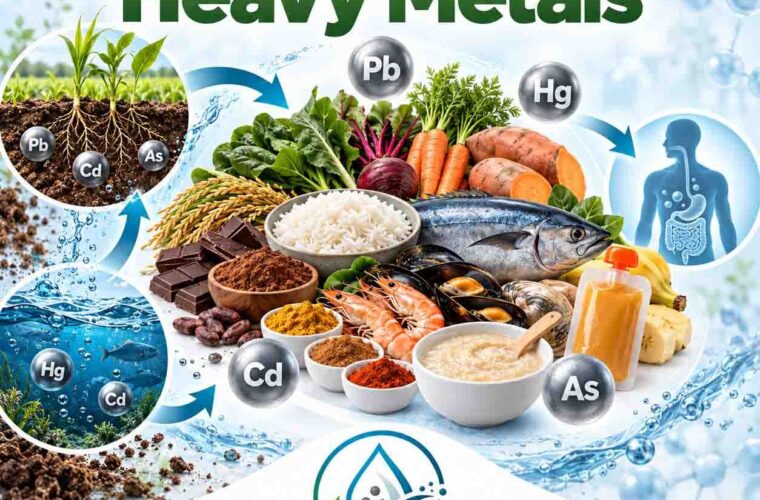
The most important contaminant is methylmercury, but researchers have also detected arsenic, cadmium, lead and other trace elements in canned tuna. Importantly, simply detecting a metal does not mean that the concentration represents a health hazard.
Here is what the evidence actually tells us.
Why Does Tuna Accumulate Heavy Metals?
Mercury occurs naturally in the environment, but human activity—including coal combustion, mining and industrial processes—has substantially increased the amount cycling through the atmosphere and oceans.
Once mercury enters aquatic environments, microorganisms can convert some of it into methylmercury.
This is the form that concerns toxicologists most because methylmercury:
- is efficiently absorbed from the gastrointestinal tract;
- crosses the blood-brain barrier;
- crosses the placenta;
- accumulates in fish muscle;
- becomes progressively concentrated up the marine food chain.
This last process is called biomagnification.
Small organisms absorb methylmercury. Small fish eat those organisms. Larger fish then eat many smaller fish. Tuna occupies relatively high positions in the marine food chain, so over several years an individual fish can accumulate appreciable quantities of mercury.
This also explains why larger and longer-lived tuna species generally contain more mercury than smaller species.
Mercury: The Main Heavy-Metal Concern in Canned Tuna
Of all the metals measured in tuna, mercury deserves the greatest attention.
In fish muscle, most mercury is present as methylmercury. Earlier analyses of canned tuna found that approximately 89% or more of total mercury could be regarded as methylmercury.
Current FDA data give average mercury concentrations of approximately:
| Tuna type | Average mercury |
| Canned light tuna | 0.13 ppm |
| Canned albacore/white tuna | 0.35 ppm |
| Yellowfin tuna | 0.35 ppm |
| Bigeye tuna | 0.69 pm |
Canned Light Tuna Versus Albacore
Canned light tuna is generally produced from smaller tuna species, most commonly skipjack.
Albacore—or “white tuna”—is a larger, longer-lived species.
The FDA states that canned albacore typically contains about three times as much mercury as canned light tuna.
For someone who eats tuna regularly, this difference is far more important than whether the tuna is packed in spring water, brine or olive oil.
Recent Research Confirms Considerable Variation Between Cans
Average figures are helpful, but they hide something important: mercury concentrations vary substantially from one fish and one can to another.
A recent study analysed 148 packaged seafood products purchased in the United States. Among tuna products, albacore contained the highest average total mercury concentration at approximately 396 ng/g, and significant differences were found between brands.
One individual albacore product exceeded the FDA’s mercury action level.
This variability occurs because a can of tuna is ultimately made from biological organisms—not a standardised chemical product.
Mercury concentration can be influenced by:
- species;
- fish size;
- fish age;
- geographical catch area;
- trophic level;
- individual feeding behaviour.
This is why choosing a generally lower-mercury species is useful even though nobody can know the precise mercury concentration of an individual can without laboratory analysis.
What About Lead and Cadmium?
Mercury receives most of the attention, but tuna can contain other toxic metals.
Studies have detected both lead (Pb) and cadmium (Cd) in canned tuna.
A study examining canned skipjack and yellowfin tuna found measurable mercury, lead and cadmium, although the canned products tested remained below the regulatory thresholds used by the researchers.
A 2025 investigation of canned tuna marketed in Turkey similarly analysed a broad range of elements. Cadmium was detected in only a small proportion of sample groups, while lead was detected in one group at a comparatively higher concentration.
More recently, an analysis of 105 canned tuna samples found that tested products complied with regulatory limits for lead, although mercury showed considerably greater variability.
The practical message is therefore:
Lead and cadmium contamination can occur, but mercury is generally the metal of greatest concern when discussing ordinary tuna consumption.
That does not make monitoring for the other metals unnecessary. It simply puts their relative importance into perspective.
What About Arsenic in Tuna?
This is where interpreting laboratory results becomes particularly important.
Several analyses report measurable—and sometimes apparently high—total arsenic concentrations in tuna.
For example, a 2025 canned-tuna study measured total arsenic concentrations between approximately 0.27 and 1.75 mg/kg.
A newer survey reported still greater variation in total arsenic.
That sounds alarming until we ask an essential toxicological question:
Which form of arsenic?
Arsenic exists in many chemical forms, and they do not have equal toxicity.
In marine fish, most arsenic is generally present as organic arsenic compounds, particularly arsenobetaine.
Research reviews suggest that arsenobetaine can account for more than 90% of total arsenic in many fish. Inorganic arsenic—the form of greatest toxicological concern—is generally a much smaller fraction.
For example, one yellowfin-tuna investigation measured approximately 0.98 mg/kg total arsenic, while estimated inorganic arsenic was only around 0.05 mg/kg.
This is why I would be cautious about interpreting a laboratory report that simply says “total arsenic.”
Arsenic speciation matters enormously.
Does the Can Itself Add Metals?
It is reasonable to wonder whether the can is responsible for the metal content.
For mercury, the answer is largely no.
The mercury has accumulated in the tuna during its life in the ocean. It is already incorporated into the muscle before the fish reaches the cannery.
Modern food cans are designed to minimise migration of packaging metals into food, although elements such as tin are monitored in canned products.
Recent canned-tuna surveys have included tin and other packaging-related elements, with tested samples generally remaining within applicable regulatory limits.
The word “canned” therefore should not distract us from the main determinant of mercury burden: the tuna itself.
Does Canning Remove Mercury?
Unfortunately, conventional food preparation does not provide a reliable way of removing mercury from tuna.
Mercury—particularly methylmercury—is bound to proteins within fish muscle rather than being concentrated simply in the skin or fat.
Health Canada therefore states that normal cooking methods such as frying, grilling or poaching do not remove mercury from fish.
The FDA gives similar advice: because mercury occurs throughout the tissue, cleaning or cooking fish will not substantially reduce the amount present.
Some experimental studies suggest that heat processing can alter how bioaccessible methylmercury becomes during digestion, possibly because heat changes the structure of mercury-binding proteins. However, this should not be interpreted as meaning that canned tuna has somehow been “detoxified.”
An interesting new development
There is emerging food-science research attempting to remove mercury before consumption.
A 2026 study treated tuna with an L-cysteine solution and reported reductions of approximately 48% in canned tuna and 64% in fresh fillets under the experimental conditions.
This is interesting research, but it is not yet a standard household recommendation or established commercial process.
For now, choosing lower-mercury fish remains much more practical than attempting to remove mercury after purchase.
Why Is Methylmercury a Health Concern?
Methylmercury is primarily a neurotoxicant.
The developing nervous system is particularly sensitive, which is why fish-consumption recommendations place special emphasis on:
- pregnancy;
- women who may become pregnant;
- breastfeeding;
- infants and young children.
Prenatal methylmercury exposure at sufficiently high levels can interfere with the developing brain and nervous system.
The US EPA’s reference dose for methylmercury is 0.1 µg/kg body weight per day.
In Europe, EFSA currently retains a tolerable weekly intake of:
1.3 µg methylmercury/kg body weight/week.
EFSA reviewed the issue again in 2026 and stated that the existing methylmercury TWI remains valid pending any future updated assessment.
It is worth remembering that these are chronic-exposure benchmarks, not thresholds at which a single tuna sandwich suddenly becomes toxic.
The pattern of intake over time matters.
How Much Canned Tuna Can We Eat?
This is probably the question most readers actually want answered.
FDA/EPA advice currently places:
Canned light tuna
“Best Choices”
For pregnant or breastfeeding adults, this category can generally be eaten 2–3 servings per week, while varying the fish consumed.
Canned albacore/white tuna
“Good Choices”
The advice is one serving per week, with no additional fish from other categories that week under the pregnancy/child guidance.
Bigeye tuna
“Choice to Avoid”
Bigeye is a larger predatory tuna with much higher average mercury concentrations.
For adults, an FDA serving is about 4 oz or 113 g.
Children require smaller age-appropriate portions.
Is Tuna Still a Healthy Food?
This is an important part of the discussion.
We should not make the mistake of examining mercury while ignoring everything else in the fish.
Tuna provides:
- high-quality protein;
- selenium;
- vitamin B12;
- omega-3 fatty acids;
- other micronutrients.
Fish in general provides EPA and DHA omega-3 fatty acids, selenium, iodine, choline, iron, zinc and vitamin D in varying amounts. Fish consumption forms part of dietary patterns associated with cardiovascular and developmental benefits.
The aim is therefore not necessarily: “Stop eating fish.”
A more scientifically reasonable message is:
Eat fish but choose species intelligently and vary what you eat.
Does Selenium Protect Against Mercury?
Tuna is naturally rich in selenium, and selenium and mercury have an interesting biochemical relationship.
Selenium participates in antioxidant enzymes and thyroid metabolism, while mercury binds strongly to selenium-containing compounds.
Experimental evidence suggests that selenium status may influence some aspects of mercury toxicity.
However, the interaction is complicated, and researchers do not currently regard selenium content as a licence to ignore mercury exposure.
In other words: selenium is nutritionally beneficial, but it does not make high-mercury tuna harmless.
Regulatory advice continues to be based largely on actual methylmercury exposure.
Is Tuna in Oil Safer Than Tuna in Water?
Probably not in any predictable way.
A recent US investigation found no significant overall effect of packaging medium on mercury concentration.
Another recent Turkish study observed higher concentrations of several elements—including mercury—in some oil-packed tuna products.
That difference does not necessarily mean oil itself caused the mercury. Species selection, fish size, source population and manufacturing practices may all confound comparisons.
I would therefore choose tuna based primarily on:
- species,
- serving frequency,
- reputable sourcing,
rather than expecting olive oil versus spring water to solve the mercury issue.
Can You “Detox” Mercury After Eating Tuna?
For ordinary dietary exposure, the most effective strategy is remarkably simple: reduce continuing exposure.
Methylmercury does leave the body gradually, but repeated intake can maintain body levels.
I would be cautious with claims that a supplement can somehow neutralise a high-mercury diet.
There is research into nutrients and substances that interact with metals, but the evidence does not support using supplements as permission to repeatedly consume high-mercury fish.
When clinically significant mercury exposure is suspected, testing and management should be supervised by an appropriately qualified practitioner or toxicologist rather than based solely on symptoms.
For most people, the first intervention is: choose lower-mercury seafood.
Where the HMD® Triple-Action System Fits In
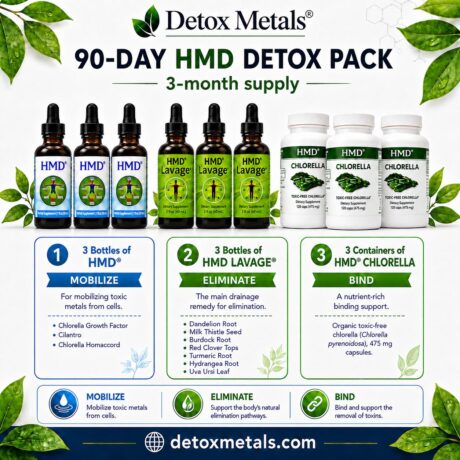
For people who eat tuna regularly and are concerned about ongoing mercury exposure, our approach is not simply to add a single “detox” supplement. The HMD® Detox Packs are built around what we call the HMD® Triple-Action System—a three-part strategy designed to support the different stages involved in reducing the body’s overall metal burden.
The system combines three complementary actions:
- Mobilise – HMD® contains a carefully formulated combination including Coriandrum sativum (cilantro) and Chlorella Growth Factor, designed to support the mobilisation of stored metals from tissues.
- Bind – HMD® Organic Chlorella provides a binding component within the gastrointestinal tract, helping capture material released into the digestive system so that it can be carried out through the stool rather than continually recirculating.
- Support elimination and drainage – HMD LAVAGE® contains herbs traditionally used to support liver, kidney, lymphatic and gastrointestinal elimination pathways, helping the body maintain the normal routes through which unwanted compounds are excreted.
This mobilise → bind → eliminate concept is the reason we prefer a combined protocol rather than relying on a single ingredient. The HMD® Detox Packs bring these components together into a structured programme that can be used when reducing ongoing sources of metal exposure, such as frequent consumption of higher-mercury fish.
It is important, however, to keep this in perspective. The best first step with dietary mercury is always to reduce continuing exposure—for example, choosing canned light or skipjack tuna more often than albacore and varying tuna with lower-mercury fish. Nutritional detoxification support should complement exposure reduction, not replace it.
Anyone with suspected significant mercury toxicity, neurological symptoms, pregnancy, kidney disease or a known high exposure should seek appropriate medical and laboratory assessment before beginning a detoxification programme.
Learn more: The HMD® Detox Packs are designed to provide the complete Tri-Active approach in one structured programme, rather than asking the user to assemble individual detoxification products separately.
My Practical Approach to Buying Canned Tuna
If tuna is a regular part of the diet, I would use a few straightforward rules:
- Choose canned light/skipjack more often than albacore.
- Treat white/albacore tuna as an occasional choice rather than the default.
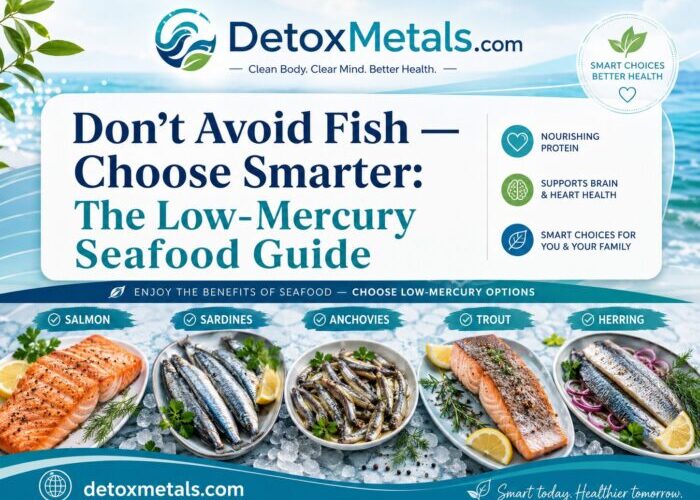
- Vary tuna with lower-mercury seafood such as salmon, sardines, trout, shrimp or pollock.
- Pay particular attention to intake during pregnancy and childhood.
- Don’t assume draining, rinsing or cooking will remove methylmercury.
- Remember that different cans and brands can vary considerably.
- Don’t panic over occasional tuna consumption—the concern is predominantly repeated exposure over time.
The Bottom Line
So, is canned tuna contaminated with heavy metals?
Yes—but that statement needs context.
Mercury occurs naturally in tuna, predominantly as methylmercury, and concentrations vary considerably according to tuna species and individual fish.
Canned albacore generally contains significantly more mercury than canned light tuna, while bigeye tuna contains still more.
Lead and cadmium can also be detected, but studies generally identify mercury as the principal metal concern in tuna muscle.
Total arsenic may appear relatively high in laboratory analyses, but most arsenic in finfish is typically organic arsenic—particularly arsenobetaine—rather than the much more toxic inorganic forms.
The evidence therefore does not support eliminating all canned tuna from the diet.
It supports something more sensible:
Choose smaller tuna species, eat a variety of seafood, pay attention to frequency, and be particularly careful during pregnancy and childhood.
Canned tuna can remain a useful food. The key is understanding that not all tuna is equal when it comes to mercury.
Scientific References
- U.S. Food and Drug Administration & Environmental Protection Agency. Advice About Eating Fish. FDA. U.S. Food and Drug Administration
- U.S. FDA. Technical Information on Development of FDA/EPA Advice About Eating Fish. Mercury concentrations in commercial fish. U.S. Food and Drug Administration
- European Food Safety Authority. Metals as contaminants in food – Mercury. Current methylmercury TWI: 1.3 µg/kg body weight/week. European Food Safety Authority
- U.S. Environmental Protection Agency. Mercury exposure and methylmercury reference dose. US EPA
- Burger J, Gochfeld M. Mercury in canned tuna: white versus light and temporal variation. Environmental Research. 2004. HERO
- Variability of Mercury Concentrations Across Species, Brand, and Tissue Type in Processed Commercial Seafood Products. 2025. PubMed Central (PMC)
- Comprehensive analysis of nutritive and toxic metal contents in canned tuna: Implications for safety and consumer health. Journal of Food Composition and Analysis. 2025;137:106893. ScienceDirect
- Abolghait SK et al. Determination of cadmium, lead and mercury residual levels in canned light tuna. Open Veterinary Journal. 2015. PubMed Central (PMC)
- Mineral and heavy metal content in canned tuna: implications for veterinary public health and consumer safety. 2026. PubMed Central (PMC)
- Luvonga C et al. Organoarsenicals in seafood: occurrence, dietary exposure, toxicity and risk-assessment considerations. 2020. PubMed Central (PMC)
- Taylor V et al. Human exposure to organic arsenic species from seafood. 2017. PubMed Central (PMC)
- Metal Load of Potentially Toxic Elements in Yellowfin Tuna—Food Safety Aspects. 2023. PubMed Central (PMC)
- Afonso C et al. Benefits and risks associated with raw, cooked and canned tuna based on bioaccessibility of selenium and methylmercury. Environmental Research. 2015. PubMed
- Spanu D et al. Detoxification of tuna from mercury through L-cysteine: a speciation-based study. Food Chemistry. 2026. PubMed
- Selenium Status: Its Interactions with Dietary Mercury Exposure and Implications in Human Health. 2023. PubMed Central (PMC)
Suggested meta description:
How much mercury is really in canned tuna? We examine research on mercury, arsenic, lead and cadmium, compare light tuna with albacore, and explain how much tuna is considered safe to eat.