


Beyond Your Birthday:
Are Toxic Metals Accelerating Your Biological Clock?
PODCAST: Antiaging, Biological Clock & Toxic Metals
Emerging research links lead and cadmium exposure with markers of faster biological ageing. What does that mean for your health—and can reducing exposure make a difference?
Your birth certificate tells you how many years you have lived. It cannot tell you everything about how your body is ageing.
Researchers are increasingly investigating why people of the same age can have different levels of physical resilience, disease risk and cellular change. Alongside familiar influences such as smoking, diet and exercise, environmental exposures are attracting attention.
Among them are toxic metals.
Recent human studies have linked lead and cadmium exposure with changes in molecular measurements known as epigenetic clocks. These findings raise an intriguing question: could some of the substances we encounter throughout life contribute to the biological processes associated with ageing?
The evidence is worth exploring. Understanding its limits is equally valuable.
Your biological age: more than a number
Chronological age is straightforward: the time since you were born. Biological age is an attempt to describe aspects of your body’s condition using measurable biological features.
One approach examines DNA methylation—chemical marks attached to DNA that help regulate how genetic information is used without changing its underlying sequence.
Scientists have developed algorithms called epigenetic clocks that analyse patterns in these marks. Some were designed primarily to estimate chronological age; others incorporate information related to health risks or the pace of ageing.
These clocks provide a window into ageing biology, but they do not all measure the same thing.
A result suggesting “accelerated ageing” therefore needs context. It does not mean every organ has aged by an identical amount, or that a particular number of years has been lost from someone’s life.
Researchers continue to investigate how accurately clock results reflect underlying ageing processes and how best to interpret changes in an individual. They are research tools with promise, rather than definitive personal health verdicts.
What the latest human research shows
Lead and cadmium in older US adults
A study published in Chemosphere in 2025 analysed 2,201 adults aged 50 and older using data from the US National Health and Nutrition Examination Survey collected in 1999–2002.
Researchers compared blood lead and cadmium levels with eight DNA methylation-based ageing measures.
Higher metal levels were associated with accelerated ageing according to several—but not all—of the measures. Associations remained after adjustment for a range of demographic, lifestyle and health factors. Smoking also had a pronounced relationship with certain clock results.
Because the study was cross-sectional, exposure and ageing measurements were examined at the same general point in time. It could identify relationships but could not establish that the metals caused accelerated ageing or that removing them would reverse it. Ryoo and colleagues, 2025.
Evidence from the Strong Heart Study
A separate study published in Environment International in 2023 examined urinary metals and DNA methylation-based ageing measures in 2,301 American Indian participants in the Strong Heart Study.
Cadmium showed particularly consistent associations with GrimAge acceleration and a faster estimated pace of ageing measured by DunedinPACE. Findings differed across metals and clocks; the research did not show a uniform effect for every element examined.
This matters because “heavy metals” is a broad label. Different elements have different biological roles and toxic effects, and exposure measurements require individual interpretation.
Together, these studies make environmental metals a credible subject for ageing research. They do not establish metal removal as an anti-ageing treatment.
Why scientists think a connection is plausible
Ageing involves interacting processes, including changes in gene regulation, mitochondrial dysfunction, cellular senescence and chronic inflammation.
Mitochondria help supply cells with energy. Senescence describes a state in which cells stop dividing and can influence surrounding tissues. These processes feature in the scientific framework known as the “hallmarks of ageing”.
Laboratory research offers possible connections between metal exposure and some of these processes. For example, experimental work on cadmium has investigated oxidative damage and cellular senescence. A 2024 study of cells from intervertebral discs reported that cadmium induced oxidative stress and senescence through a specific cellular signalling pathway.
Such experiments help researchers develop explanations to test in people. They cannot tell us how much everyday exposure changes an individual’s ageing trajectory, or whether a supplement would prevent those changes.
A plausible biological mechanism is a reason to investigate a treatment—not proof that the treatment works.
The bigger picture: a lifetime of exposures
Environmental health researchers use the term exposome to describe the exposures a person experiences throughout life and their biological effects.
This includes pollution and workplace chemicals, but also diet, smoking and other features of our surroundings and behaviour.
In a 2025 NIEHS discussion, environmental-health researcher Andrea Baccarelli explained how epigenetic patterns can help scientists investigate the lasting molecular traces of environmental exposures.
This approach expands the conversation about healthy ageing. Our genes matter, but so do the conditions in which we live and work.
Where do lead and cadmium exposures come from?
Exposure depends on location, occupation, housing, habits and other circumstances.
Lead can be encountered through contaminated dust and soil, deteriorating lead-containing paint, certain manufacturing and recycling activities, and drinking water affected by lead-containing plumbing. Some traditional medicines, cosmetics and consumer products can also be sources.
Lead can accumulate in bones and teeth. Its established health effects include damage to the nervous system and kidneys, and increased cardiovascular risk. These are reasons to prevent exposure regardless of what future ageing-clock research discovers.
Cadmium exposure can occur through contaminated food, tobacco smoke and certain workplaces. WHO identifies kidney, skeletal and respiratory toxicity among its health effects and recognises cadmium as a human carcinogen.
The useful response is to identify credible sources of exposure. Detecting a metal in a sample does not, by itself, establish poisoning or a need for treatment.
Could lowering metal levels slow ageing?
This is an important research question, but it remains unanswered.
Three separate findings would be needed to support an anti-ageing claim:
- An exposure contributes to harmful biological changes.
- An intervention safely reduces the relevant exposure or body burden.
- That intervention improves meaningful health outcomes.
Evidence for one step does not automatically establish the others.
The TACT2 trial illustrates this distinction. In people with diabetes and a previous heart attack, an EDTA-based chelation regimen lowered median blood lead levels by approximately 61% but did not reduce the trial’s primary cardiovascular outcome.
TACT2 was not an ageing study and did not test HMD®. Its relevance is the broader lesson: improving a laboratory measurement does not necessarily improve health.
Similarly, an intervention that changes an epigenetic clock would still need further evidence before researchers could conclude that it preserves independence, prevents disease or extends life.
What can you do now?
There is no need to wait for a definitive anti-ageing trial before addressing a genuine environmental exposure.
If your work, home or personal history suggests significant exposure, discuss it with a qualified healthcare professional. Testing should be selected for the particular metal and circumstances.
Blood lead testing, for example, has an established role in assessing lead exposure. Appropriate urine tests can help investigate certain other metals.
Be cautious about interpreting urine collected after taking a chelating agent. The American College of Medical Toxicology advises against using these “provoked” tests to diagnose metal poisoning: the results are not comparable with ordinary reference ranges and may lead to unnecessary treatment.
For healthy ageing more broadly, established priorities remain valuable: regular physical activity, nutritious food, adequate sleep and appropriate medical care. These support health independently of whether an ageing-clock score changes.
Physical activity is particularly useful for maintaining strength, mobility and independence, while reducing the risk of several chronic diseases.
Where does the HMD® detox protocol fit into healthy ageing?
For readers interested in HMD®, it is helpful to separate the programme’s intended purpose from benefits that have been demonstrated.
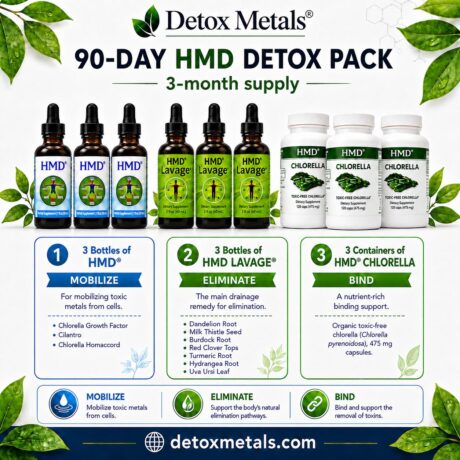
The HMD® protocol described on Detox Metals combines three products:
- HMD®: a formulation containing chlorella growth factor, coriander leaf tincture and a chlorella-based homaccord. This is the main MOBILZER that pulls heavy metals from inside the cells.
- HMD® Organic Chlorella: a companion supplement that acts as a BINDER – binding to heavy metals to prevent their reabsorption.
- HMD LAVAGE®: a herbal formulation marketed for elimination support.
The programme is presented as an approach to metal detoxification. Its proposed sequence of mobilising, binding and eliminating metals is the manufacturer’s explanation; it should not be treated as an independently established account of what happens throughout the human body.
What has been studied?
A 2018 paper by HMD® ’s developer, Dr George Georgiou, describes research on natural substances in metal-exposed workers and reports increases in selected metals measured in urine and faeces following HMD® administration.
These findings concern excretion measurements. The report has limitations in methodological and statistical reporting and does not establish a sustained reduction in total body burden or a resulting health benefit.
It also did not assess epigenetic ageing, frailty, lifespan or prevention of age-related disease. Research on a formulation or short-term excretion cannot establish the effectiveness of the complete multi-product protocol.
Can HMD® help with anti-ageing?
There is currently insufficient clinical evidence to say that HMD® slows or reverses biological ageing.
The proposed rationale is that reducing a harmful metal burden might reduce one source of biological stress. Whether HMD® achieves that sufficiently and safely to produce an anti-ageing benefit has not been demonstrated.
For someone considering HMD®, a sensible first step is an individual assessment of exposure, health conditions and medications. A clinician or pharmacist can help evaluate whether the ingredients are appropriate. Suspected metal poisoning requires medical assessment; supplements should not replace indicated treatment.
Readers can learn more about the HMD® protocol and discuss its suitability with their healthcare professional. The goal should be a clear, evidence-based health decision, with realistic expectations about what the available research can—and cannot—promise.
Scientific references and further reading
- Ryoo SW, et al. Lead and cadmium exposure was associated with faster epigenetic aging in a representative sample of adults aged 50 and older in the United States. Chemosphere. 2025;374:144194. doi:10.1016/j.chemosphere.2025.144194.
- Metal mixtures and DNA methylation measures of biological aging in American Indian populations. Environment International. 2023;178:108064. doi:10.1016/j.envint.2023.108064.
- López-Otín C, Blasco MA, Partridge L, Serrano M, Kroemer G. Hallmarks of aging: An expanding universe. Cell. 2023;186:243–278. doi:10.1016/j.cell.2022.11.001.
- Cadmium-induced annulus fibrosus cell senescence contributes to intervertebral disc degeneration via the JNK/p53 signaling pathway. 2024. PubMed record.
- Lamas GA, et al. Edetate disodium–based chelation for patients with a previous myocardial infarction and diabetes: TACT2 randomized clinical trial. JAMA. 2024;332:794–803. doi:10.1001/jama.2024.11463.
- American College of Medical Toxicology. ACMT recommends against use of post-chelator challenge urinary metal testing. Journal of Medical Toxicology. 2017;13:352–354. doi:10.1007/s13181-017-0624-6.
- Georgiou G. Scientific research on natural heavy metal chelators: testing what works. International Journal of Complementary & Alternative Medicine. 2018;11:262–267. doi:10.15406/ijcam.2018.11.00409. Product-developer-authored research; not an anti-ageing trial.
- NIEHS. Epigenetics and the exposome: A new era of disease prevention. February 2025. Research discussion.
This article provides general health information and is not a diagnosis or an individual treatment plan.