




CHILDREN AND HEAVY METALS

Heavy Metals in Baby Foods
PODCAST: HEAVY METALS IN BABY FOODS Heavy Metals in Baby Foods Why Parents Are Asking Better Questions Why This Conversation Matters There are few things more personal than feeding

Fish is one of the most valuable foods in a healthy diet. It provides high-quality protein, iodine, selenium, vitamin D, vitamin B12 and the long-chain omega-3 fats EPA and DHA, which support the brain, eyes, heart, blood vessels and healthy development during pregnancy and childhood.
The problem is not the fish itself. The problem is choosing fish without understanding mercury.
For many people, the answer to mercury in fish has become too extreme: “Avoid fish.” That is not the best message.
A smarter, more scientifically balanced approach is to eat fish regularly, but choose the right fish. Lower-mercury seafood allows you to receive the nutritional benefits of fish while reducing unnecessary exposure to methylmercury.
Mercury exists in different chemical forms, but the form most associated with seafood is methylmercury. Methylmercury forms in aquatic environments and moves up the food chain.
Small organisms are eaten by small fish, small fish are eaten by larger fish, and large predatory fish can accumulate higher mercury levels over time. This is why size, age and feeding pattern matter when choosing seafood.
Large predatory fish generally contain more mercury because they live longer and eat many smaller fish throughout their lifespan.
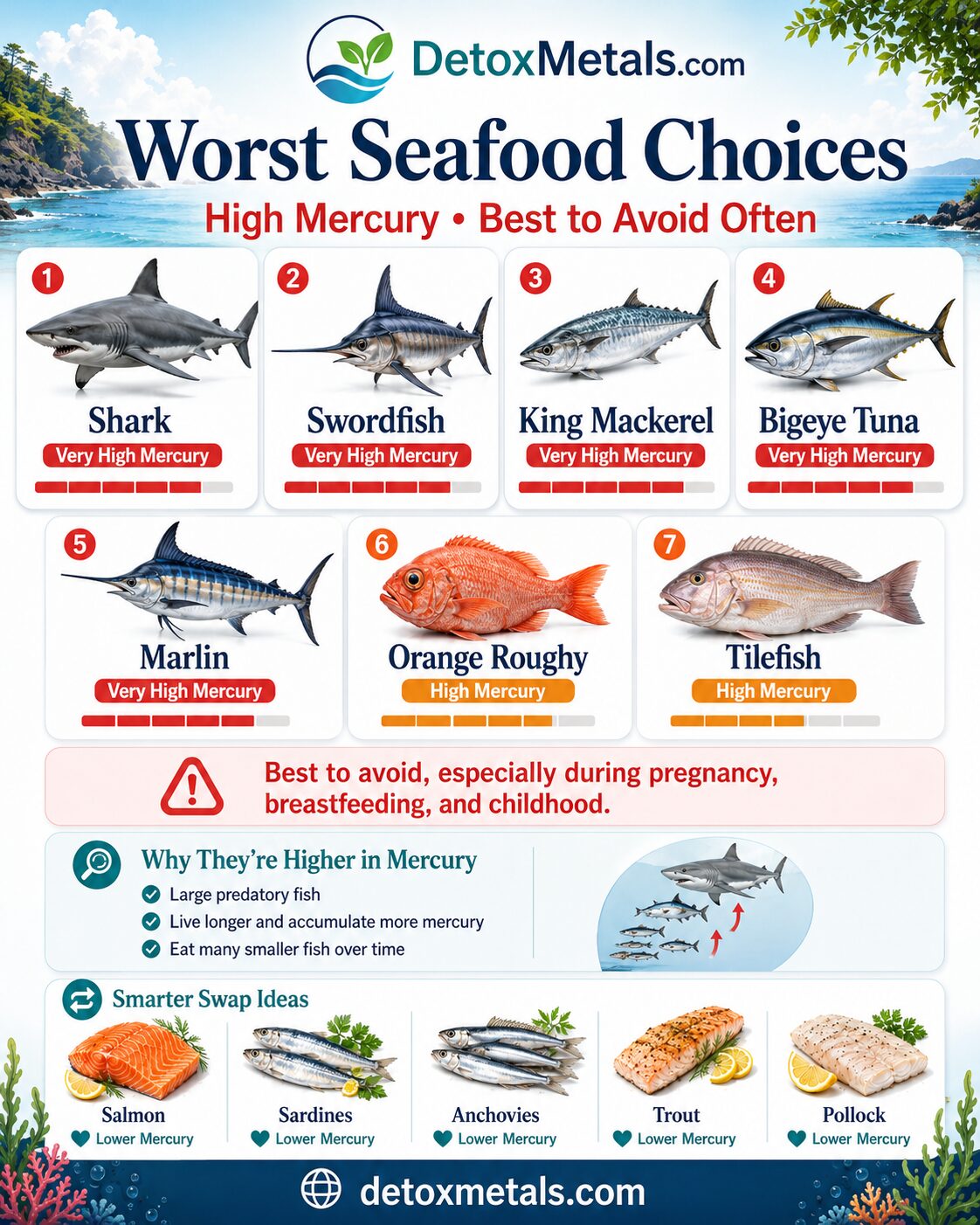
Shark, swordfish, king mackerel, marlin, orange roughy, tilefish from the Gulf of Mexico and bigeye tuna are listed by FDA/EPA among the highest-mercury fish to avoid, especially for pregnant women, breastfeeding mothers and children.
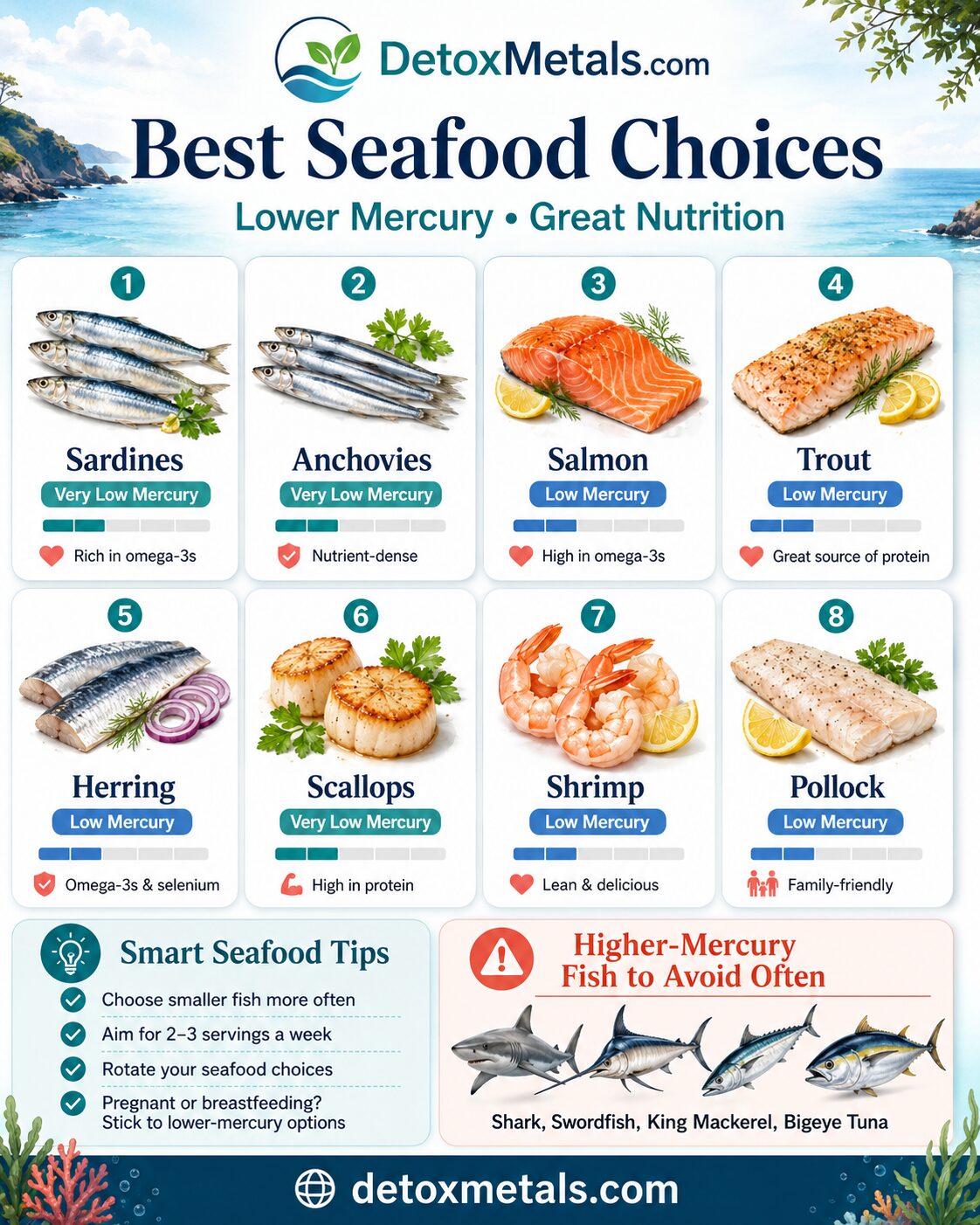
The good news is that many nutritious fish are naturally lower in mercury. FDA/EPA lists anchovies, sardines, salmon, trout, herring, Atlantic mackerel, cod, pollock, tilapia, shrimp, scallops, clams and canned light tuna among “Best Choices.” These smaller or lower-trophic-level seafood options are generally better choices for regular consumption.
For pregnancy and breastfeeding, official FDA/EPA advice recommends 8–12 ounces per week of a variety of seafood, choosing lower-mercury options.
That usually means 2–3 servings per week from the “Best Choices” list, or one serving from the “Good Choices” list.
This advice is important because fish provide nutrients that support fetal brain and eye development, while high-mercury choices should be avoided.
The developing nervous system is particularly sensitive to methylmercury exposure. Prenatal exposure has been associated in scientific literature with subtle effects on neurodevelopment, but research also shows that eating appropriate, lower-mercury fish during pregnancy can provide benefits.
This is why the message must be precise: avoid high-mercury fish, but do not remove nutritious low-mercury seafood without reason.
EPA and DHA are two omega-3 fatty acids found mainly in fish and seafood. DHA is concentrated in the brain and retina and is especially important during pregnancy, infancy and early childhood.
Seafood also contributes to cardiovascular nutrition, and major health organisations have long recognised that fish can be part of a heart-supportive eating pattern.
The smartest seafood strategy is to prioritise smaller oily fish. Sardines, anchovies, salmon, trout and herring are excellent examples because they provide valuable omega-3 fats while generally being lower in mercury than large predatory species.
In practical terms, the smaller fish that are lower on the food chain often give you more nutritional benefit with less toxic burden.
Tuna deserves special mention because not all tuna is the same. FDA/EPA classifies canned light tuna, which includes skipjack, as a “Best Choice,” while albacore/white tuna and yellowfin tuna are “Good Choices,” meaning they should be eaten less often. Bigeye tuna is listed as a fish to avoid due to elevated mercury levels.
A practical weekly plan might include salmon once or twice, sardines or anchovies once, and a lighter seafood option such as cod, trout, pollock, shrimp or scallops.
This provides variety, reduces dependence on a single species, and helps avoid repeated intake of higher-mercury fish. Variety is one of the easiest ways to lower risk while keeping seafood in the diet.
For children, the same principle applies, but with smaller portions. FDA/EPA recommends that children eat fish from the lower-mercury “Best Choices” list, with serving sizes adjusted to age.
Parents should be especially careful to avoid giving children high-mercury fish because children’s brains and nervous systems are still developing.
Fish caught by family or friends requires extra caution. Local rivers, lakes, and coastal areas can have specific fish advisories due to mercury or other contaminants. FDA/EPA recommends checking local fish and shellfish advisories; if no advisory is available, eat only one serving of that fish and no other fish that week.
Cooking fish does not remove mercury. Mercury is bound within the fish tissue, so grilling, baking, steaming or frying will not make a high-mercury fish low in mercury.
This means the most important decision happens before cooking: choose the right species, the right portion and the right frequency.
It is also important not to assume that “wild” automatically means low mercury or that “expensive” means safer. Mercury levels depend more on species, size, age, feeding patterns, and water source than on price or marketing language.
A large predatory wild fish may have more mercury than a smaller, lower-mercury species.
For people who eat fish very often, especially tuna steaks, swordfish, shark, large predatory fish or frequent sushi made with high-mercury species, it may be wise to review cumulative exposure.
Symptoms of mercury burden can be vague and may overlap with many other conditions, so testing and professional interpretation are better than guessing.
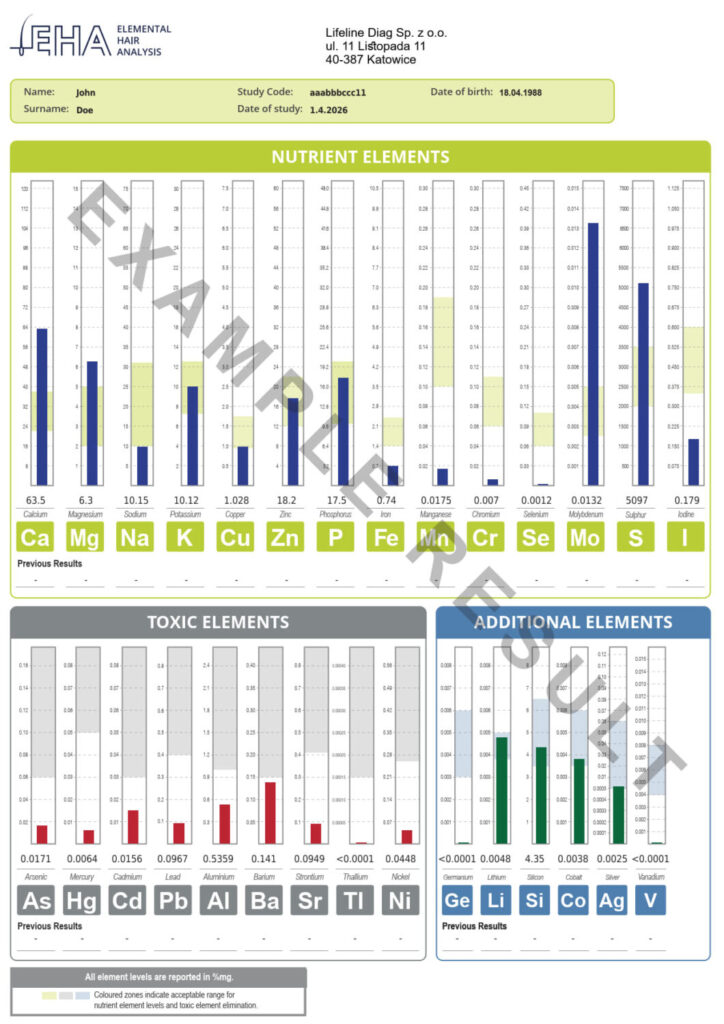
Hair mineral analysis can be a useful non-invasive way to examine longer-term patterns of mineral and toxic element deposition, including mercury.
However, it should be interpreted responsibly, alongside exposure history, symptoms, diet, occupation, dental history, and other relevant testing where needed.
It should not be used as an emergency toxicology test. See how to purchase a hair test online.
At DetoxMetals.com, our philosophy is not fear-based avoidance. The better goal is intelligent exposure reduction, nutritional support and safe monitoring.
In the case of fish, that means keeping seafood in the diet where appropriate, choosing lower-mercury species, avoiding high-mercury fish, and using testing when there is a realistic concern about accumulated exposure.
A simple rule is this: eat small, oily, lower-mercury fish more often; eat larger predatory fish rarely or not at all; and be especially careful during pregnancy, breastfeeding and childhood.
This strategy protects the benefits of seafood while reducing the toxic burden associated with repeated methylmercury exposure.
Good regular choices include salmon, sardines, anchovies, trout, herring, Atlantic mackerel, cod, pollock, tilapia, shrimp, scallops, clams and canned light tuna. These are generally better, everyday or weekly choices than large predatory fish.
High-mercury fish to avoid include shark, swordfish, king mackerel, marlin, orange roughy, tilefish from the Gulf of Mexico and bigeye tuna. These are especially important to avoid during pregnancy, breastfeeding and childhood.
Choose smaller fish more often. Choose variety instead of eating the same fish repeatedly. Use salmon, sardines, anchovies and trout as regular choices. Limit albacore/white tuna and yellowfin tuna. Avoid bigeye tuna, shark, swordfish and king mackerel. Check local advisories for fish caught by family or friends. Do not assume cooking removes mercury. Consider hair testing if exposure has been frequent or long-term.
Fish is not the enemy. Poor seafood choices are the problem. With the right strategy, you can enjoy the brain, heart and developmental benefits of seafood while lowering your exposure to mercury. The goal is not to eat any fish. The goal is to eat smarter fish.

PODCAST: HEAVY METALS IN BABY FOODS Heavy Metals in Baby Foods Why Parents Are Asking Better Questions Why This Conversation Matters There are few things more personal than feeding

PODCAST: HEAVY METALS IN A MODERN LIFESTYLE Heavy Metals in a Modern Lifestyle The New Detox Problem How everyday food, air, water, products and technology may be adding to our

PODCAST: Wildfire Smoke, Toxic Ash, and Heavy Metals in Our Air Wildfire Smoke, Toxic Ash and Heavy Metals The Hidden Side of Air Pollution Wildfire smoke is no longer