


How to Reduce Your Heavy Metal Exposure
You may not have much control over the air you breathe or the exhaust from the traffic in your town. But you can influence other potential sources of heavy metal exposure.
The most significant risks for heavy metals stem from the foods you eat, the water you drink, the products you use, and certain exposures inside your own home.
Top Heavy Metal Risk #1 — Food
When it comes to having control over your heavy metal contact, a great place to start is by evaluating your everyday food choices.
Certain foods are known to be at higher risk for containing heavy metals, so avoiding them can help remove unnecessary exposure.
Heavy metals are a concern to pregnant and breastfeeding women since they can pass through both the placenta and breastmilk. Weaning babies and toddlers are also at risk because heavy metals have even been found in commercial foods targeted at them — both organic and non-organic.
Heavy metals are especially prevalent in products that are rice-based. (More on that below.) Young kids are also at a higher risk of metal toxicity because their smaller bodies are more susceptible to absorbing and retaining them.
Even though organic foods can still contain heavy metals present in soil, they have the benefit of not being exposed to nearly as many pesticides. (Ideally, they are not exposed to any!)
A recent study by Newcastle University found that conventionally-grown food had ten to 100 times more pesticides than organic food. What do pesticides have to do with heavy metals? Many pesticides contain inorganic heavy metals.
3 Types of Food That May be of Particular Concern for Heavy Metals
Fish
Mercury is commonly discovered in large, predatory fish. This is because these fish tend to live longer than smaller organisms, where mercury ingestion and absorption often originate in the ocean.
Algae and plankton absorb mercury, which small fish eat. Bigger fish will then eat the small fish. And even larger fish will eat those fish — moving up to the top of the food chain, with an ever-increasing accumulation of mercury in the tissues of the fish.
Unfortunately, the very top of the food chain could be you if you have a big fish on your dinner plate.
Some of the most at-risk fish for mercury contamination include tuna, king mackerel, marlin, orange roughy, shark, swordfish, and tilefish.
Rice
Rice is an inexpensive, versatile, and nutritious food item. However, recent research has found that, regardless of the variety, rice is one of the most arsenic-contaminated foods on store shelves.
Brown rice is among the worst. Studies conducted by Consumer Reports found that brown rice actually had 80% more arsenic than white rice. This is because arsenic accumulates in the outer grain, which is removed to make white rice. Infant rice cereal contains around six times as much arsenic as baby cereals made from other grains.
The arsenic content in rice can vary depending on where in the world it grows. Whether it grows organically or conventionally, however, has no meaningful relevance to its arsenic content. Testing also shows that grains like quinoa, amaranth, bulgur, farro, polenta, and millet typically contain little if any arsenic.
And here’s some other good news: Cooking methods can help reduce the arsenic content of rice. Rinse rice before cooking, and then cook it using a water to rice ratio of 6:1, draining off excess water when done.
Researchers also found that cooking rice in a coffee pot can reduce its arsenic content by up to 85%. You can make a risotto that will really wake you up in the morning! (For more about arsenic in rice, check out our article here.)
Bone Broth
Though marketed as something of a miracle elixir for all manner of health benefits, bone broth can be a significant source of lead.
This is because bones store lead. And when you cook the bones or many hours to make bone broth, the contents of the bones will remain in the end product.
A 2013 study published in Medical Hypotheses found that even bone broth made from organic chicken bones had “markedly high lead concentrations,” as compared to water cooked in the same pot. (For more on the health considerations related to bone broth, see this article.)
Top Heavy Metal Risk #2 — Drinking Water
Heavy metals enter the groundwater through soil contamination of underground aquifers.
It might be a good idea to have your water tested for heavy metals, especially if you have a well or if your home has older plumbing.
The tragic case of contaminated drinking water that most recently dominated the headlines is in Flint, Michigan. In 2014, government officials eager to save money replaced properly treated water from Lake Huron with improperly treated water from the Flint River.
The 100,000 residents of the city were exposed to lead leaching from old pipes. Local physicians alerted the public of high lead levels in resident children in 2015.
Despite all the attention on Flint, it is far from the only area with a lead problem.
According to an investigation published in the Washington Post in 2016 based on EPA records, “Lead taints water across the U.S.”
The report went on to describe that an estimated 20% of the water systems in the U.S. have unsafe levels of lead. Among these water systems, 350 daycare centers and schools failed lead tests a total of 470 times between 2012 and 2015. In New Jersey alone, 11 cities had even more dangerously high lead levels than Flint.
Is this problem limited to the United States? No. According to a 2014 story in the Irish Times, lead contamination levels up to 80 times the legal limit were detected in drinking water in Dublin. And an estimated 40% of properties in the UK connect to the water supply main by lead pipes that are leaching lead into municipal drinking water.
Fortunately, modern technology can reduce and even remove heavy metals, like lead.
One way to do this is by investing in a high-quality water filtration system for your home water. This may include distillation, ion exchange, reverse osmosis, or an activated carbon filtration system. Different products will remove different toxins and metals. Look third-party tested products. This ensures they will indeed remove what they claim to remove from your water.
(For more on drinking water and water treatment options, check out our article on water here. And for one of my favorite water filter options, and a special price for Food Revolution readers, check out the AquaTru, here.)
Top Heavy Metal Risk #3 — Consumer Products
Heavy metals, including iron, mercury, arsenic, lead, chromium, aluminum, and zinc, have been found in popular personal care products, like makeup, whitening toothpaste, sunscreen, eye drops, and nail polish.
In a 2013 study published in Environmental Health Perspectives, researchers tested 32 lipsticks for lead — and found that 75% of the lipstick samples contained detectable lead levels.
Want to find safer cosmetics and personal care products? Check out the Environmental Working Group’s Skin Deep database.
Heavy metals in personal care products may result from contamination. But sometimes, they’re actually added ingredients. Manufacturers often use aluminum in cookware, including aluminum pots and pans. Fortunately, safer alternatives are available, like stainless steel.
Top Heavy Metal Risk #4 — Your Home Air
Though at lower concentrations than in food, heavy metals also exist in the air.
Arsenic is one of the most common metals in the atmosphere. There are higher concentrations of it near cities.
Other airborne heavy metals include cadmium, chromium, and nickel. Why are these substances floating around? Mainly because of certain human activities, like driving cars, running heavily-polluting industrial businesses, and using aerosol products.
How do you clean up the air you breathe?
One option is to get a home air purifier that filters out heavy metals. You might also want to consider making it a household rule for everyone to remove their shoes before walking around inside. This prevents tracking heavy metals around the house and then kicking them up and inhaling them.
(For more on my favorite indoor air purifier, the Air Doctor Pro, click here.)
Foods to Help You with Heavy Metal Detoxification
The best thing you can do to prevent heavy metals from building up in your body is to avoid excessive exposure in the first place. However, you can’t count on attaining perfect success.
When your body is working as it was designed to, it can protect you from many of the heavy metals you are exposed to without them doing you harm.
Every time I stand behind a bus as it starts up, I feel like I need a detox! But that doesn’t mean I want to live in such a way that I never wind up standing on busy streets.
When your body is working as it was designed to, it can protect you from many of the heavy metals you are exposed to without them doing you harm.
And certain foods and nutrients may help your body remove heavy metals.
Here are six of them:
Heavy Metal Detox Food #1 — Cruciferous Vegetables
Your liver has enzymes that work to flush toxins from your body.
You can boost the efficacy of these enzymes by eating cruciferous vegetables, such as broccoli, bok choy, cauliflower, Brussels sprouts, and kale.
Heavy Metal Detox Food #2 — Fiber
Fiber — found only in plant foods — can help bind to cadmium, arsenic, mercury, lead, copper, and aluminum. This makes it easier for your body to clear them out.
This mechanism is called Metals Capturing Capacity. Researchers have found that foods naturally high in insoluble fiber may be particularly good at binding dietary mercury.
Heavy Metal Detox Food #3 — Phytates
A compound in plant foods called phytates. They inhibit iron absorption, can help remove excess iron in the body.
Grains, nuts, and legumes all contain phytates.
Heavy Metal Detox Food #4 — Probiotics
Probiotics may also play a role in helping your body clear away heavy metals.
Research shows Lactobacillus acidophilus and Bifidobacterium lactis bacteria are effective in reducing oral lead exposure in the brains of rats.
A 2014 study published in the journal American Society for Microbiology looked at the effects of probiotics on mercury and arsenic absorption in the body. The researchers found that yogurt infused with Lactobacillus rhamnosus was protective for pregnant women against mercury absorption by up to 36% and against arsenic by up to 78%.
Heavy Metal Detox Food #5 — Cilantro
While more research is needed, some scientists think that cilantro may help reduce the toxic effects of heavy metals.
Some researchers suggest that eating cilantro alongside commonly contaminated food items, at the same meal, may reduce the body’s absorption of heavy metals. Another study suggests that cilantro may increase urinary excretion of mercury, lead, and aluminum.
Heavy Metal Detox Food #6 — Black Sesame Seeds
Black sesame seeds may also help remove heavy metals from the body.
Research indicates that their ability to bind lead, cadmium, and mercury may be due to powerful phytochemicals known as lignans. Black sesame seeds seem to bind more effectively to these heavy metals than to lighter essential metals, like iron, calcium, and zinc.
How do you use them? You can easily sprinkle black sesame seeds onto most any dish or even add them to smoothies. A delicious way to detox!
Can Other Foods Help Protect You from Heavy Metals?
Research has indicated several other foods with the potential for removing certain heavy metals — specifically, cadmium and iron — from the body.
Diets high in soybeans, onions, curry paste, and grapes have been shown to have a beneficial effect on cadmium levels and have actually reversed damage to various organs and tissues.
Other studies have shown that diets high in garlic, ginger, green tea, and tomato paste, help to heal damage caused by excessive iron exposure.
Algae, such as chlorella and spirulina, have also improved kidney, liver, and brain damage induced by cadmium and iron. This is thought to be due to the high antioxidant content of algae.
(Interested in trying spirulina, but not sure how to use it? Check out this “Heavy Metal Detox Smoothie” from Food Revolution Summit speaker Anthony William.)
Does Sweating It Out Help Detox from Heavy Metals?
Some health advocates have proposed that sweating can help remove certain heavy metals. Strenuous exercise or regular sauna baths can therefore enhance a heavy metal detox.
While this may be true, no large controlled trials are illustrating it or offering specific evidence-based guidance. That doesn’t mean it doesn’t help. It simply means that we don’t know.
The most proven heavy metal detoxification intervention appears to come from efforts to clean up the environment and eat foods that promote your body’s natural capacity to detoxify.
Natural Heavy Metal Detox
Reading this article, one can conclude that heavy metals are ubiquitous. So what can we do about these worrisome heavy metals?
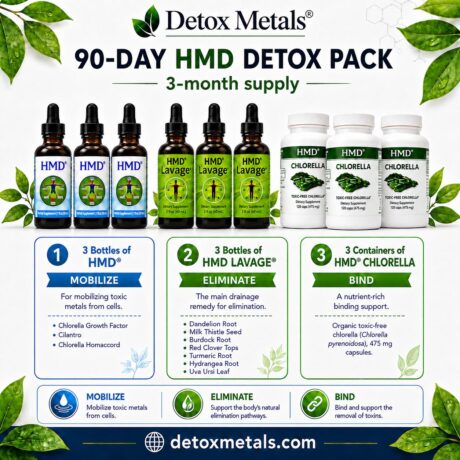
One natural option is a toxic metal formulation such as HMD®.
We recommend you take the HMD™ Ultimate Detox Pack which contains the HMD™ (Heavy Metal Detox) as well as LAVAGE, a herbal drainage remedy and organic CHLORELLA.
Please ask a qualified practitioner before giving any supplement to a child.
Begin a heavy metal detox using HMD™ – designed for eliminating heavy metals naturally!
HMD™ is a Heavy Metal Detox formulation for removing heavy metals from body!
Try a Heavy Metal Detox Smoothie regularly to maintain optimal health and well-being!